Thursday, 16 November 2017

Matrix

In order to arrange numerous numbers, mathematics provides a simple solution: matrices. A matrix can be defined as a rectangular grid of numbers, symbols, and expressions arranged in rows and columns. These grids are usually charted by brackets around them.
The dimensions of a matrix are represented as R X C, where R is the number of rows and C is the number of columns. This R X C notation is also called the order of the matrix.

Types of Matrices

There are various types of matrices, depending on their structure. Let's explore the most common types:

Null Matrix

A matrix that has all 0 elements is called a null matrix. It can be of any order. For example, we could have a null matrix of the order 2 X 3. It's also a singular matrix, since it does not have an inverse and its determinant is 0.

Null Matrix

Any matrix that does have an inverse can be called a regular matrix.

Row Matrix

row matrix is a matrix with only one row. Its order would be 1 X C, where C is the number of columns. For example, here's a row matrix of the order 1 X 5:

Row Matrix

Column Matrix

column matrix is a matrix with only one column. It is represented by an order of R X 1, where R is the number of rows. Here's a column matrix of the order 3 X 1:

Column Matrix

Square Matrix

A matrix where the number of rows is equal to the number of columns is called a square matrix. Here's a square matrix of the order 2 X 2:

Square Matrix

Diagonal Matrix

diagonal matrix is a square matrix where all the elements are 0 except for those in the diagonal from the top left corner to the bottom right corner. Let's take a look at a diagonal matrix of order 4 X 4:

Diagonal Matrix

A special type of diagonal matrix, where all the diagonal elements are equal is called a scalar matrix. We can see a 3 X 3 scalar matrix here:

Scalar Matrix

A scalar matrix whose diagonal elements are all 1 is called a unit matrix, or identity matrix.


Unit Matrix

Thursday, 2 November 2017

The matrix in mathematics is a rectangular or square array of numbers or variables, arranged in the form of rows and columns. Individual items in a matrix are known as elements or entries.
The size of the matrix is determined by some its rows and columns. Matrix with ‘m’ rows and ‘n’ columns is read as ‘m*n’ matrix where m and n are its dimensions.
A=123456789101112
For example ,the matrix A mentioned above  is a 3*4 matrix ,where 1,5,9,2,6 etc are its elements.
Matrices Problems
Two matrices can be added or subtracted element by element, provided both are of the same size.
Below image will help us in understanding the addition and subtraction operation on matrices,
Application Of Matrices
But there is a rule for matrix multiplication, the number of columns in the first matrix should be equal to a number of rows in the second.
If A is a matrix of m*n and B is a matrix of n*p then their product matrix C=(A*B) will be m*p, whose elements are produced by the dot product of a corresponding row of A and a corresponding column of B.
Application Of Matrices
The above image gives us a better understanding of multiplication of matrices.

Friday, 6 October 2017

Algebra - Basic Definitions

It may help you to read Introduction to Algebra first

What is an Equation

An equation says that two things are equal. It will have an equals sign "=" like this:
x+2=6
That equation says: what is on the left (x + 2) is equal to what is on the right (6)
So an equation is like a statement "this equals that"

Parts of an Equation

So people can talk about equations, there are names for different parts (better than saying "that thingy there"!)
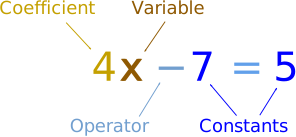
Here we have an equation that says 4x − 7 equals 5, and all its parts:
4x-7=5: 4 is coefficient, x is variable, 7 and 5 constant, - is operator
Variable is a symbol for a number we don't know yet. It is usually a letter like x or y.
A number on its own is called a Constant.
Coefficient is a number used to multiply a variable (4x means 4 times x, so 4 is a coefficient)
Variables on their own (without a number next to them) actually have a coefficient of 1 (x is really 1x)
Sometimes a coefficient is a letter like a or b instead of a number:

Example: ax2 + bx + c

  • x is a variable
  • a and b are coefficients
  • c is a constant
An Operator is a symbol (such as +, ×, etc) that shows an operation (ie we want to do something with the values).

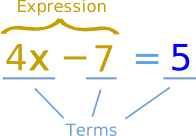
4x-7=5: 4x-7 is expression, 4x, 7 and 5 are terms
Term is either a single number or a variable, or numbers and variables multiplied together.
An Expression is a group of terms (the terms are separated by + or − signs)
So, now we can say things like "that expression has only two terms", or "the second term is a constant", or even "are you sure the coefficient is really 4?"

Exponents

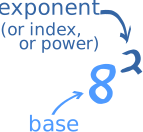
8 to the Power 2The exponent (such as the 2 in x2) says how many times to use the value in a multiplication.
Examples:
82 = 8 × 8 = 64
y3 = y × y × y
y2z = y × y × z
Exponents make it easier to write and use many multiplications
Example: y4z2 is easier than y × y × y × y × z × z, or even yyyyzz

Polynomial

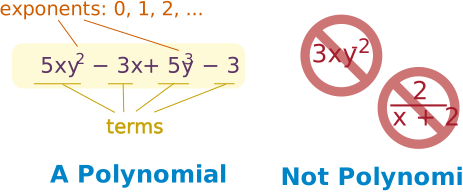
Example of a Polynomial: 3x2 + x - 2
polynomial can have constantsvariables and the exponents 0,1,2,3,...
But it never has division by a variable.
polynomial

Monomial, Binomial, Trinomial

Friday, 22 September 2017

Can trigonometry be used in everyday life?

Trigonometry may not have its direct applications in solving practical issues, but it is used in various things that we enjoy so much. For example music, as you know sound travels in waves and this pattern though not as regular as a sine or cosine function, is still useful in developing computer music. A computer cannot obviously listen to and comprehend music as we do, so computers represent it mathematically by its constituent sound waves. And this means sound engineers need to know at least the basics of trigonometry. And the good music that these sound engineers produce is used to calm us from our hectic, stress full life – All thanks to trigonometry.

Trigonometry can be used to measure the height of a building or mountains:

if you know the distance from where you observe the building and the angle of elevation you can easily find the height of the building. Similarly, if you have the value of one side and the angle of depression from the top of the building you can find and another side in the triangle, all you need to know is one side and angle of the triangle.
tajj

Trigonometry in video games:

Have you ever played the game, Mario? When you see him so smoothly glide over the road blocks. He doesn’t really jump straight along the Y axis, it is a slightly curved path or a parabolic path that he takes to tackle the obstacles on his way. Trigonometry helps Mario jump over these obstacles. As you know Gaming industry is all about IT and computers and hence Trigonometry is of equal importance for these engineers.
games

Trigonometry in construction:

In construction we need trigonometry to calculate the following:
  • Measuring fields, lots and areas;
  • Making walls parallel and perpendicular;
  • Installing ceramic tiles;
  • Roof inclination;
  • The height of the building, the width length etc. and the many other such things where it becomes necessary to use trigonometry.
Architects use trigonometry to calculate structural load, roof slopes, ground surfaces and many other aspects, including sun shading and light angles.

Trigonometry in flight engineering:

Flight engineers have to take in account their speed, distance, and direction along with the speed and direction of the wind. The wind plays an important role in how and when a plane will arrive where ever needed this is solved using vectors to create a triangle using trigonometry to solve. For example, if a plane is travelling at 234 mph, 45 degrees N of E, and there is a wind blowing due south at 20 mph. Trigonometry will help to solve for that third side of your triangle which will lead the plane in the right direction, the plane will actually travel with the force of wind added on to its course.

Trigonometry in physics:

In physics, trigonometry is used to find the components of vectors, model the mechanics of waves (both physical and electromagnetic) and oscillations, sum the strength of fields, and use dot and cross products. Even in projectile motion you have a lot of application of trigonometry.

Monday, 18 September 2017

Parallelogram (Coordinate Geometry)
 
quadrilateral with both pairs of opposite sides parallel and congruent, and whose location on the coordinate plane is determined by the coordinates of the four vertices (corners).
Try this Drag any vertex of the parallelogram below. It will remain a parallelogram and its dimensions calculated from its coordinates. You can also drag the origin point at (0,0).
In coordinate geometry, a parallelogram is similar to an ordinary parallelogram (See parallelogram definition ) with the addition that its position on the coordinate plane is known. Each of the four vertices (corners) have known coordinates. From these coordinates, various properties such as its altitude can be found.
It has all the same properties as a familiar parallelogram:
  • Opposite sides are parallel and congruent
  • The diagonals bisect each other
  • Opposite angles are congruent
See parallelogram definition for more.

Sides and diagonals

The lengths of the four sides and two diagonals can be found by using the method described in Distance between two points to find the distance between point pairs.
For example, in the figure above click 'reset' and select "show diagonals' in the options menu. Using the method in Distance between two points, the diagonal AC is the distance between the points A and C:
Diagonal AC
=
(
48
6
)
2
+
(
26
7
)
2
=
46.1

Similarly the side AB can be found using the coordinates of the points A and B:
Side AB
=
(
18
6
)
2
+
(
26
7
)
2
=
22.5

Altitude

The altitude of a parallelogram is the perpendicular distance from a vertex to the opposite side (base). In the figure above select "Show Altitude" in the options menu. It will show the altitude from B to the opposite side AB.
The calculate the length of an altitude, we need to find the perpendicular distance from a point to a line. In the above figure we need the distance from B to the line AD.

Friday, 8 September 2017


Applications of Trigonometry in Real life

  • Trigonometry is commonly used in finding the height of towers and mountains.


  • It is used in navigation to find the distance of the shore from a point in the sea.

  • It is used in oceanography in calculating the height of tides in oceans


  • It is used in finding the distance between celestial bodies


  • The sine and cosine functions are fundamental to the theory of periodic functions such as those that describe sound and light waves.


  • Architects use trigonometry  to calculate structural load, roof slopes, ground surfaces and many other aspects, including sun shading and light angles


Thursday, 31 August 2017

How to Find the Mode or Modal Value

The mode is simply the number which appears most often.

Finding the Mode

To find the mode, or modal value, first put the numbers in order, then count how many of each number. A number that appears most often is the mode.

Example:

3, 7, 5, 13, 20, 23, 39, 23, 40, 23, 14, 12, 56, 23, 29
In order these numbers are:
3, 5, 7, 12, 13, 14, 20, 23, 23, 23, 23, 29, 39, 40, 56
This makes it easy to see which numbers appear most often.
In this case the mode is 23.

Another Example: {19, 8, 29, 35, 19, 28, 15}

Arrange them in order: {8, 15, 19, 19, 28, 29, 35}
19 appears twice, all the rest appear only once, so 19 is the mode.
How to remember? Think "mode is most"

More Than One Mode

We can have more than one mode.

Example: {1, 3, 3, 3, 4, 4, 6, 6, 6, 9}

3 appears three times, as does 6.
So there are two modes: at 3 and 6
Having two modes is called "bimodal".
Having more than two modes is called "multimodal".

Grouping

When all values appear the same number of times the idea of a mode is not useful. But we could group them to see if one group has more than the others. 

Example: {4, 7, 11, 16, 20, 22, 25, 26, 33}

Each value occurs once, so let us try to group them.
We can try groups of 10:
  • 0-9: 2 values (4 and 7)
  • 10-19: 2 values (11 and 16)
  • 20-29: 4 values (20, 22, 25 and 26)
  • 30-39: 1 value (33)
In groups of 10, the "20s" appear most often, so we could choose 25 (the middle of the 20s group) as the mode.
You could use different groupings and get a different answer!