Thursday, 31 August 2017

How to Find the Mode or Modal Value

The mode is simply the number which appears most often.

Finding the Mode

To find the mode, or modal value, first put the numbers in order, then count how many of each number. A number that appears most often is the mode.

Example:

3, 7, 5, 13, 20, 23, 39, 23, 40, 23, 14, 12, 56, 23, 29
In order these numbers are:
3, 5, 7, 12, 13, 14, 20, 23, 23, 23, 23, 29, 39, 40, 56
This makes it easy to see which numbers appear most often.
In this case the mode is 23.

Another Example: {19, 8, 29, 35, 19, 28, 15}

Arrange them in order: {8, 15, 19, 19, 28, 29, 35}
19 appears twice, all the rest appear only once, so 19 is the mode.
How to remember? Think "mode is most"

More Than One Mode

We can have more than one mode.

Example: {1, 3, 3, 3, 4, 4, 6, 6, 6, 9}

3 appears three times, as does 6.
So there are two modes: at 3 and 6
Having two modes is called "bimodal".
Having more than two modes is called "multimodal".

Grouping

When all values appear the same number of times the idea of a mode is not useful. But we could group them to see if one group has more than the others. 

Example: {4, 7, 11, 16, 20, 22, 25, 26, 33}

Each value occurs once, so let us try to group them.
We can try groups of 10:
  • 0-9: 2 values (4 and 7)
  • 10-19: 2 values (11 and 16)
  • 20-29: 4 values (20, 22, 25 and 26)
  • 30-39: 1 value (33)
In groups of 10, the "20s" appear most often, so we could choose 25 (the middle of the 20s group) as the mode.
You could use different groupings and get a different answer!

Thursday, 24 August 2017

How to Find the Median Value

It's the middle of a sorted list of numbers.

Median Value

The Median is the "middle" of a sorted list of numbers.

How to Find the Median Value

To find the Median, place the numbers in value order and find the middle.

Example: find the Median of 12, 3 and 5

Put them in order:
3, 5, 12
The middle is 5, so the median is 5.


Example: 

3, 13, 7, 5, 21, 23, 39, 23, 40, 23, 14, 12, 56, 23, 29

When we put those numbers in order we have:
3, 5, 7, 12, 13, 14, 21, 23, 23, 23, 23, 29, 39, 40, 56

There are fifteen numbers. Our middle is the eighth number:
3, 5, 7, 12, 13, 14, 21, 23, 23, 23, 23, 29, 39, 40, 56

The median value of this set of numbers is 23.

(It doesn't matter that some numbers are the same in the list.)

Two Numbers in the Middle

BUT, with an even amount of numbers things are slightly different.

In that case we find the middle pair of numbers, and then find the value that is half waybetween them. This is easily done by adding them together and dividing by two.

Example:

3, 13, 7, 5, 21, 23, 23, 40, 23, 14, 12, 56, 23, 29

When we put those numbers in order we have:
3, 5, 7, 12, 13, 14, 21, 23, 23, 23, 23, 29, 40, 56

There are now fourteen numbers and so we don't have just one middle number, we have a pair of middle numbers:
3, 5, 7, 12, 13, 14, 2123, 23, 23, 23, 29, 40, 56

In this example the middle numbers are 21 and 23.
To find the value halfway between them, add them together and divide by 2:
21 + 23 = 44
then 44 ÷ 2 = 22

So the Median in this example is 22.

Thursday, 17 August 2017

Histograms

Histogram: a graphical display of data using bars of different heights.

Histogram
It is similar to a Bar Chart, but a histogram groups numbers into ranges
And you decide what ranges to use!

orange orchard

Example: Height of Orange Trees

You measure the height of every tree in the orchard in centimeters (cm)
The heights vary from 100 cm to 340 cm
You decide to put the results into groups of 50 cm:
  • The 100 to just below 150 cm range,
  • The 150 to just below 200 cm range,
  • etc...
So a tree that is 260 cm tall is added to the "250-300" range.
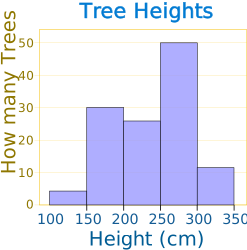
And here is the result:
histogram heights
You can see (for example) that there are 30 trees from 150 cm to just below 200 cm tall

The horizontal axis is continuous like a number linehistogram x axis

puppy

Example: How much is that puppy growing?

Each month you measure how much weight your pup has gained and get these results:
0.5, 0.5, 0.3, −0.2, 1.6, 0, 0.1, 0.1, 0.6, 0.4
They vary from −0.2 (the pup lost weight that month) to 1.6
Put in order from lowest to highest weight gain:
−0.2, 0, 0.1, 0.1, 0.3, 0.4, 0.5, 0.5, 0.6, 1.6
You decide to put the results into groups of 0.5:
  • The −0.5 to just below 0 range,
  • The 0 to just below 0.5 range,
  • etc...
And here is the result:
histogram weight change
(There are no values from 1 to just below 1.5, but we still show the space.)
The range of each bar is also called the Class Interval
In the example above each class interval is 0.5

Thursday, 10 August 2017

Factoring in Algebra

Factors

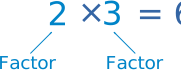
Numbers have factors:
factors 2x3=6
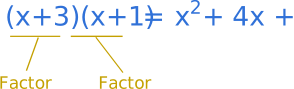
And expressions (like x2+4x+3) also have factors:
factors

Factoring

Factoring (called "Factorising" in the UK) is the process of finding the factors:
Factoring: Finding what to multiply together to get an expression.
It is like "splitting" an expression into a multiplication of simpler expressions.

Example: factor 2y+6

Both 2y and 6 have a common factor of 2:
  • 2y is 2 × y
  • 6 is 2 × 3
So we can factor the whole expression into:
2y+6 = 2(y+3)
So 2y+6 has been "factored into" 2 and y+3
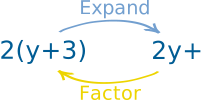
Factoring is also the opposite of Expanding:
expand vs factor

Common Factor

In the previous example we saw that 2y and 6 had a common factor of 2
But to do the job properly we need the highest common factor, including any variables

Example: factor 3y2+12y

Firstly, 3 and 12 have a common factor of 3.
So we could have:
3y2+12y = 3(y2+4y)
But we can do better!
3y2 and 12y also share the variable y.
Together that makes 3y:
  • 3y2 is 3y × y
  • 12y is 3y × 4

So we can factor the whole expression into:
3y2+12y = 3y(y+4)

Check: 3y(y+4) = 3y × y + 3y × 4 = 3y2+12y

Thursday, 3 August 2017

Linear Equations

linear equation is an equation for a straight line

These are all linear equations:

yes y = 2x + 1
yes 5x = 6 + 3y
yes y/2 = 3 − x
Let us look more closely at one example:

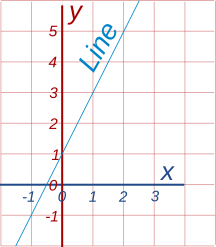
Example: y = 2x + 1 is a linear equation:

line on a graph
The graph of y = 2x+1 is a straight line

  • When x increases, y increases twice as fast, so we need 2x
  • When x is 0, y is already 1. So +1 is also needed
  • And so: y = 2x + 1
Here are some example values:
xy = 2x + 1
-1y = 2 × (-1) + 1 = -1
0y = 2 × 0 + 1 = 1
1y = 2 × 1 + 1 = 3
2y = 2 × 2 + 1 = 5
Check for yourself that those points are part of the line above!

Different Forms

There are many ways of writing linear equations, but they usually have constants (like "2" or "c") and must have simple variables (like "x" or "y").

Examples: These are linear equations:

yes y = 3x − 6
yes y − 2 = 3(x + 1)
yes y + 2x − 2 = 0
yes 5x = 6
yes y/2 = 3
But the variables (like "x" or "y") in Linear Equations do NOT have:

Examples: These are NOT linear equations:

not y2 − 2 = 0
not 3√x − y = 6
not x3/2 = 16

Slope-Intercept Form

The most common form is the slope-intercept equation of a straight line:
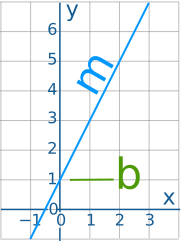
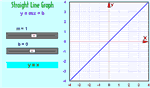
y=mx+b graph
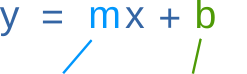
Equation of a Straight Line y=mx+b
Slope (or Gradient)Y Intercept
 

Example: y = 2x + 1

  • Slope: m = 2
  • Intercept: b = 1
Animation 

Play With It !

You can see the effect of different values of m and b at Explore the Straight Line Graph

Thursday, 27 July 2017

Distance Between 2 Points

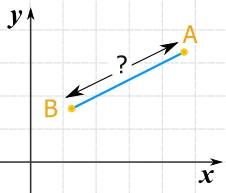
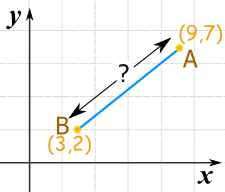
Here is how to calculate the distance between two points when you know their coordinates:
graph 2 points

Let us call the two points A and B

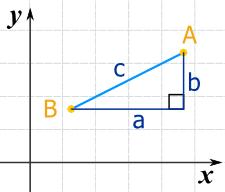
graph 2 points
We can run lines down from A, and along from B, to make a Right Angled Triangle.
And with a little help from Pythagoras we know that:
a2 + b2 = c2

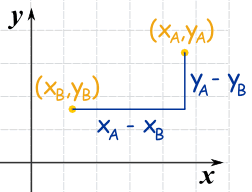
graph 2 points
Now label the coordinates of points A and B.
xA means the x-coordinate of point A
yA means the y-coordinate of point A
The horizontal distance a is (xA − xB)
The vertical distance b is (yA − yB)

Now we can solve for c (the distance between the points):
Start with:c2 = a2 + b2
Put in the calculations for a and b:c2 = (xA − xB)2 + (yA − yB)2
And the final result:c = square root of [(xA-xB)^2+(yA-yB)^2]

Examples

Example 1

graph 2 points

Fill in the values: c = square root of [(9-3)^2+(7-2)^2]
   
c = square root of [6^2+5^2] = square root of 61

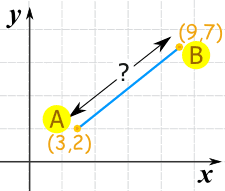
Example 2

It doesn't matter what order the points are in, because squaring removes any negatives:
graph 2 points

Fill in the values: c = square root of [(3-9)^2+(2-7)^2]
   
c = square root of [(-6)^2+(-5)^2] = square root of 61


Thursday, 20 July 2017

Introduction to Coordinate Geometry
A system of geometry where the position of points on the plane is described using an ordered pair of numbers.
Recall that a plane is a flat surface that goes on forever in both directions. If we were to place a point on the plane, coordinate geometry gives us a way to describe exactly where it is by using two numbers.

What are coordinates?

Grid with rows and columns labelled.To introduce the idea, consider the grid on the right. The columns of the grid are lettered A,B,C etc. The rows are numbered 1,2,3 etc from the top. We can see that the X is in box D3; that is, column D, row 3.
D and 3 are called the coordinates of the box. It has two parts: the row and the column. There are many boxes in each row and many boxes in each column. But by having both we can find one single box, where the row and column intersect.

The Coordinate Plane

In coordinate geometry, points are placed on the "coordinate plane" as shown below. It has two scales - one running across the plane called the "x axis" and another a right angles to it called the y axis. (These can be thought of as similar to the column and row in the paragraph above.) The point where the axes cross is called the origin and is where both x and y are zero.
coordinate plane showing x-axis, y-axis and origin
On the x-axis, values to the right are positive and those to the left are negative.
On the y-axis, values above the origin are positive and those below are negative.
A point's location on the plane is given by two numbers,the first tells where it is on the x-axis and the second which tells where it is on the y-axis. Together, they define a single, unique position on the plane. So in the diagram above, the point A has an x value of 20 and a y value of 15. These are the coordinates of the point A, sometimes referred to as its "rectangular coordinates". Note that the order is important; the x coordinate is always the first one of the pair.
For a more in-depth explanation of the coordinate plane see The Coordinate Plane.
For more on the coordinates of a point see Coordinates of a Point

Things you can do in Coordinate Geometry

If you know the coordinates of a group of points you can:
  • Determine the distance between them
  • Find the midpoint, slope and equation of a line segment
  • Determine if lines are parallel or perpendicular
  • Find the area and perimeter of a polygon defined by the points
  • Transform a shape by moving, rotating and reflecting it.
  • Define the equations of curves, circles and ellipses.