Monday, 18 September 2017

Parallelogram (Coordinate Geometry)
 
quadrilateral with both pairs of opposite sides parallel and congruent, and whose location on the coordinate plane is determined by the coordinates of the four vertices (corners).
Try this Drag any vertex of the parallelogram below. It will remain a parallelogram and its dimensions calculated from its coordinates. You can also drag the origin point at (0,0).
In coordinate geometry, a parallelogram is similar to an ordinary parallelogram (See parallelogram definition ) with the addition that its position on the coordinate plane is known. Each of the four vertices (corners) have known coordinates. From these coordinates, various properties such as its altitude can be found.
It has all the same properties as a familiar parallelogram:
  • Opposite sides are parallel and congruent
  • The diagonals bisect each other
  • Opposite angles are congruent
See parallelogram definition for more.

Sides and diagonals

The lengths of the four sides and two diagonals can be found by using the method described in Distance between two points to find the distance between point pairs.
For example, in the figure above click 'reset' and select "show diagonals' in the options menu. Using the method in Distance between two points, the diagonal AC is the distance between the points A and C:
Diagonal AC
=
(
48
6
)
2
+
(
26
7
)
2
=
46.1

Similarly the side AB can be found using the coordinates of the points A and B:
Side AB
=
(
18
6
)
2
+
(
26
7
)
2
=
22.5

Altitude

The altitude of a parallelogram is the perpendicular distance from a vertex to the opposite side (base). In the figure above select "Show Altitude" in the options menu. It will show the altitude from B to the opposite side AB.
The calculate the length of an altitude, we need to find the perpendicular distance from a point to a line. In the above figure we need the distance from B to the line AD.

Friday, 8 September 2017


Applications of Trigonometry in Real life

  • Trigonometry is commonly used in finding the height of towers and mountains.


  • It is used in navigation to find the distance of the shore from a point in the sea.

  • It is used in oceanography in calculating the height of tides in oceans


  • It is used in finding the distance between celestial bodies


  • The sine and cosine functions are fundamental to the theory of periodic functions such as those that describe sound and light waves.


  • Architects use trigonometry  to calculate structural load, roof slopes, ground surfaces and many other aspects, including sun shading and light angles


Thursday, 31 August 2017

How to Find the Mode or Modal Value

The mode is simply the number which appears most often.

Finding the Mode

To find the mode, or modal value, first put the numbers in order, then count how many of each number. A number that appears most often is the mode.

Example:

3, 7, 5, 13, 20, 23, 39, 23, 40, 23, 14, 12, 56, 23, 29
In order these numbers are:
3, 5, 7, 12, 13, 14, 20, 23, 23, 23, 23, 29, 39, 40, 56
This makes it easy to see which numbers appear most often.
In this case the mode is 23.

Another Example: {19, 8, 29, 35, 19, 28, 15}

Arrange them in order: {8, 15, 19, 19, 28, 29, 35}
19 appears twice, all the rest appear only once, so 19 is the mode.
How to remember? Think "mode is most"

More Than One Mode

We can have more than one mode.

Example: {1, 3, 3, 3, 4, 4, 6, 6, 6, 9}

3 appears three times, as does 6.
So there are two modes: at 3 and 6
Having two modes is called "bimodal".
Having more than two modes is called "multimodal".

Grouping

When all values appear the same number of times the idea of a mode is not useful. But we could group them to see if one group has more than the others. 

Example: {4, 7, 11, 16, 20, 22, 25, 26, 33}

Each value occurs once, so let us try to group them.
We can try groups of 10:
  • 0-9: 2 values (4 and 7)
  • 10-19: 2 values (11 and 16)
  • 20-29: 4 values (20, 22, 25 and 26)
  • 30-39: 1 value (33)
In groups of 10, the "20s" appear most often, so we could choose 25 (the middle of the 20s group) as the mode.
You could use different groupings and get a different answer!

Thursday, 24 August 2017

How to Find the Median Value

It's the middle of a sorted list of numbers.

Median Value

The Median is the "middle" of a sorted list of numbers.

How to Find the Median Value

To find the Median, place the numbers in value order and find the middle.

Example: find the Median of 12, 3 and 5

Put them in order:
3, 5, 12
The middle is 5, so the median is 5.


Example: 

3, 13, 7, 5, 21, 23, 39, 23, 40, 23, 14, 12, 56, 23, 29

When we put those numbers in order we have:
3, 5, 7, 12, 13, 14, 21, 23, 23, 23, 23, 29, 39, 40, 56

There are fifteen numbers. Our middle is the eighth number:
3, 5, 7, 12, 13, 14, 21, 23, 23, 23, 23, 29, 39, 40, 56

The median value of this set of numbers is 23.

(It doesn't matter that some numbers are the same in the list.)

Two Numbers in the Middle

BUT, with an even amount of numbers things are slightly different.

In that case we find the middle pair of numbers, and then find the value that is half waybetween them. This is easily done by adding them together and dividing by two.

Example:

3, 13, 7, 5, 21, 23, 23, 40, 23, 14, 12, 56, 23, 29

When we put those numbers in order we have:
3, 5, 7, 12, 13, 14, 21, 23, 23, 23, 23, 29, 40, 56

There are now fourteen numbers and so we don't have just one middle number, we have a pair of middle numbers:
3, 5, 7, 12, 13, 14, 2123, 23, 23, 23, 29, 40, 56

In this example the middle numbers are 21 and 23.
To find the value halfway between them, add them together and divide by 2:
21 + 23 = 44
then 44 ÷ 2 = 22

So the Median in this example is 22.

Thursday, 17 August 2017

Histograms

Histogram: a graphical display of data using bars of different heights.

Histogram
It is similar to a Bar Chart, but a histogram groups numbers into ranges
And you decide what ranges to use!

orange orchard

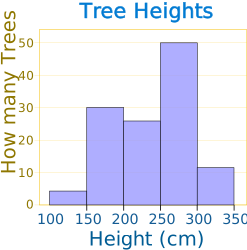
Example: Height of Orange Trees

You measure the height of every tree in the orchard in centimeters (cm)
The heights vary from 100 cm to 340 cm
You decide to put the results into groups of 50 cm:
  • The 100 to just below 150 cm range,
  • The 150 to just below 200 cm range,
  • etc...
So a tree that is 260 cm tall is added to the "250-300" range.
And here is the result:
histogram heights
You can see (for example) that there are 30 trees from 150 cm to just below 200 cm tall

The horizontal axis is continuous like a number linehistogram x axis

puppy

Example: How much is that puppy growing?

Each month you measure how much weight your pup has gained and get these results:
0.5, 0.5, 0.3, −0.2, 1.6, 0, 0.1, 0.1, 0.6, 0.4
They vary from −0.2 (the pup lost weight that month) to 1.6
Put in order from lowest to highest weight gain:
−0.2, 0, 0.1, 0.1, 0.3, 0.4, 0.5, 0.5, 0.6, 1.6
You decide to put the results into groups of 0.5:
  • The −0.5 to just below 0 range,
  • The 0 to just below 0.5 range,
  • etc...
And here is the result:
histogram weight change
(There are no values from 1 to just below 1.5, but we still show the space.)
The range of each bar is also called the Class Interval
In the example above each class interval is 0.5

Thursday, 10 August 2017

Factoring in Algebra

Factors

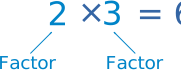
Numbers have factors:
factors 2x3=6
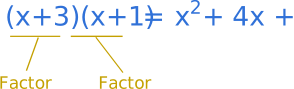
And expressions (like x2+4x+3) also have factors:
factors

Factoring

Factoring (called "Factorising" in the UK) is the process of finding the factors:
Factoring: Finding what to multiply together to get an expression.
It is like "splitting" an expression into a multiplication of simpler expressions.

Example: factor 2y+6

Both 2y and 6 have a common factor of 2:
  • 2y is 2 × y
  • 6 is 2 × 3
So we can factor the whole expression into:
2y+6 = 2(y+3)
So 2y+6 has been "factored into" 2 and y+3
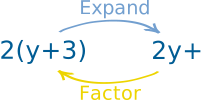
Factoring is also the opposite of Expanding:
expand vs factor

Common Factor

In the previous example we saw that 2y and 6 had a common factor of 2
But to do the job properly we need the highest common factor, including any variables

Example: factor 3y2+12y

Firstly, 3 and 12 have a common factor of 3.
So we could have:
3y2+12y = 3(y2+4y)
But we can do better!
3y2 and 12y also share the variable y.
Together that makes 3y:
  • 3y2 is 3y × y
  • 12y is 3y × 4

So we can factor the whole expression into:
3y2+12y = 3y(y+4)

Check: 3y(y+4) = 3y × y + 3y × 4 = 3y2+12y

Thursday, 3 August 2017

Linear Equations

linear equation is an equation for a straight line

These are all linear equations:

yes y = 2x + 1
yes 5x = 6 + 3y
yes y/2 = 3 − x
Let us look more closely at one example:

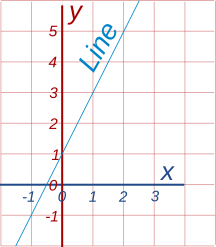
Example: y = 2x + 1 is a linear equation:

line on a graph
The graph of y = 2x+1 is a straight line

  • When x increases, y increases twice as fast, so we need 2x
  • When x is 0, y is already 1. So +1 is also needed
  • And so: y = 2x + 1
Here are some example values:
xy = 2x + 1
-1y = 2 × (-1) + 1 = -1
0y = 2 × 0 + 1 = 1
1y = 2 × 1 + 1 = 3
2y = 2 × 2 + 1 = 5
Check for yourself that those points are part of the line above!

Different Forms

There are many ways of writing linear equations, but they usually have constants (like "2" or "c") and must have simple variables (like "x" or "y").

Examples: These are linear equations:

yes y = 3x − 6
yes y − 2 = 3(x + 1)
yes y + 2x − 2 = 0
yes 5x = 6
yes y/2 = 3
But the variables (like "x" or "y") in Linear Equations do NOT have:

Examples: These are NOT linear equations:

not y2 − 2 = 0
not 3√x − y = 6
not x3/2 = 16

Slope-Intercept Form

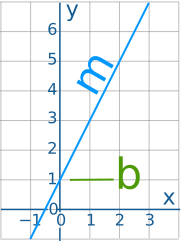
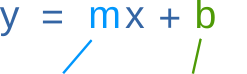
The most common form is the slope-intercept equation of a straight line:
y=mx+b graph
Equation of a Straight Line y=mx+b
Slope (or Gradient)Y Intercept
 

Example: y = 2x + 1

  • Slope: m = 2
  • Intercept: b = 1
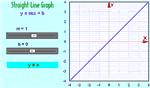
Animation 

Play With It !

You can see the effect of different values of m and b at Explore the Straight Line Graph