Wednesday, 19 April 2017

Ramanujan museum

The Ramanujan museum for math

12 AUGUST 2009 NO COMMENT
S Sundaram and Nirmala Raman
PK Srinivasan, or PKS as he was known, was a dreamer with his head in the world of mathematics but feet fi rmly on the ground. He was an ardent admirer and practically a devotee of the Indian mathematical genius Srinivasa Ramanujan.
Ramanujan-Museum
This is what he wrote in a preface to Volume 1 of the Ramanujan Memorial Number: Letters and Reminiscences he helped publish in 1968; “(the dream is to set up a) Ramanujan Memorial Foundation with the object of setting up a permanent memorial to Ramanujan in the shape of a multistoried building in Madras, housing a planetarium, mathematical exhibition wings, auditorium, library and showrooms displaying applications of mathematics in industry. It will be a house of entertainment par excellence for the layman and it will strive to make mathematics almost as popular as dance and music. We solicit generous support and help from the readers and institutions all over the globe for translation of the dream into reality.”
He had to wait for almost 25 years to atleast have a room for the memorabilia of this great mathematician and finally could accommodate it in the premises of the Avvai Cultural Academy, Royapuram, and the man who helped him realise his dream, at least partially, was Shri A.T.B Bose, a businessman interested in education.
The story of PKS’s fascination with Ramanujan and how he came to collect letters and other memorablia related to Ramanujan and how these came to be housed in the Ramanujan Museum in Chennai is a story worth recounting if only to show the power of dreams and a single-minded devotion to a cause.
PKS was introduced to the life and works of Ramanujan in 1948 through a book on “Indian Scientists’ published by G A Natesan & Co. The life sketch of Ramanujan moved him and created in him a desire to discover more about the genius.
At that time, PKS was working as a mathematics teacher in Muthialpet High School in Chennai. Through his innovative methods of teaching, PKS managed to kindle an interest in mathematics amongst his students.
PKS felt that Ramanujan’s life taught you that it was possible to reach great heights of achievement irrespective of your background if only you are true to yourself. This was something he wanted all his students to realise. He was one of the founder members of the Association of Mathematics Teachers in India (AMTI) in 1965 because of a conviction that mathematics teachers needed to have a professional platform to exchange ideas.
In 1954 PKS met Janaki Ammal and S Thirunarayanan, wife and brother of Shri Ramanujan. Subsequently he also met Ananda Rao, who was a contemporary of Ramanujan in England. He was fascinated listening to the many small and hitherto unknown incidences in Ramanujan’s life. This meeting and subsequent contacts with relatives and friends of Ramanujan encouraged PKS into thinking about collecting letters and reminiscences related to Ramanujan’s remarkable life.
In 1962, the Government of India announced the release of a special commemoration stamp marking Ramanujan’s 75th birthday on 22nd December. PKS decided to use this opportunity to bring out a memorial number on Ramanujan, containing letters and reminiscences.
With the help of his students, both former and current, he formed a committee for this purpose in October 1962. They then set about searching for contacts and institutions in India and abroad that who were connected in any way with Ramanujan.
The committee placed ads in local papers, interviewed people who had known Ramanujan and gathered letters. When he got a response to an ad or found a contact, he would immediately follow up. Often he found himself just patiently sitting while some one rummaged around in an old trunk for some half-remembered letter. Sometimes he would bring in a stenographer skilled in both English and Tamil to record a conversation.


Thursday, 13 April 2017

2D SHAPES

2D Shapes

Regular Polygons
A polygon is a plane (2D) shape with straight sides.
To be a regular polygon all the sides and angles must be the same:
2d triangle
Triangle - 3 Sides
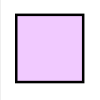
2d square
Square - 4 Sides
2d pentagon
Pentagon - 5 Sides
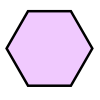
2d hexagon
Hexagon - 6 sides
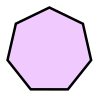
2d heptagon
Heptagon - 7 Sides
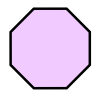
2d octagon
Octagon - 8 Sides
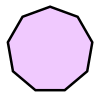
2d nonagon
Nonagon - 9 Sides
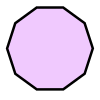
2d decagon
Decagon - 10 Sides
More ...

Other Common Polygons
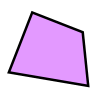
2d quadrilateral
Quadrilateral
Any 4 sided 2D shape
2d rectangle
Rectangle - 4 Sides
All right angles
And many more!

Curved Shapes
These 2D shapes have curves, so are not polygons:

2d circle
Circle
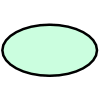
2d ellipse
Ellipse

Tuesday, 11 April 2017

amazing maths facts

Interesting and amazing maths facts

Article Category: Units  |  14 Comments

The more one studies mathematics, the more mysterious it becomes, with powers that seem quite ‘spooky’ and almost magical at times.
Maths fun - photo
Consider the Power of Pi: it seems such a simple concept, the ratio between the circumference of a circle and its diameter. As a fraction, that’s simply 22 over 7 but as an actual number, Pi is unknowable.
See the box for an approximate (!) statement of the value of Pi but in fact you could go on calculating it into eternity and never find a pattern or reach the end. So we just call it 3.142.
But consider how this “irrational” number seems to crop up everywhere. Pi is all over the natural world, wherever there’s a circle, of course, measuring patterns in the DNA double helix spiral or how ripples travel outward in water. It helps describe wave patterns or the meandering patterns of rivers.
π = 3.14159 26535 89793 23846 26433 83279 50288 41971 69399 37510 58209 74944 59230 78164 06286 20899 86280 34825 34211 70679 82148 08651 32823...
But Pi isn’t just connected with circles. For example, the probability that any two whole numbers among a random collection are "relatively prime" with no common factor is equal to 6 over Pi squared. Pi even enters into Heisenberg's Uncertainty Principle; the equation that defines how precisely we can know the state of the universe.
So Pi is just one example of the ‘magic’ of math. If you want more proof of this, consider the following:

Pi and pizzas are linked

You multiply Pi multiplied by the radius squared to find the area and multiply area by height to find the volume, That means the volume of a pizza that has a nominal radius of (z) and height (a) will, of course, be: Pi × z × z × a
And strangely, if you enter Pi to two decimal places (3.14) in the your calculator and look at it in the mirror, you’ll see it spells ‘pie’.

Nature loves Fibonacci sequences

The spiral shapes of sunflowers and other patterns in nature follow a Fibonacci sequence, where adding the two preceding numbers in the sequence gives you the next (1, 1, 2, 3, 5, 8, etc.)

In a crowded room, two people probably share a birthday

It only takes 23 people to enter a room to give you an evens chance that two of them have the same birthday. With 75 people in the room the chances rise to 99 per cent!

Multiplying ones always gives you palindromic numbers

If you multiply 111,111,111 × 111,111,111 you get 12,345,678,987,654,321 - a palindrome number that reads the same forwards or backwards. And that works all the way back down to 11 x 11 (121) or just 1 x 1 (1).

The universe isn't big enough for Googolplex

A googolplex is 10 to the power of a googol, or 10 to the power of 10 to the power of 100. Our known universe doesn’t have enough space to actually write that out on paper. If you try to do that sum on a computer, you’ll never get the answer, because it won’t have enough memory.

Seven is the favorite number

Playing cards in pocket - all sevens
You might have guessed that most people’s favorite number is 7 but that’s now been proven.
A recent online poll of 3,000 people by Alex Bellos found that around 10% of them chose seven, with three as the runner-up.
That might be because seven has so many favorable connections (seven wonders of the world, pillars of wisdom, seven seas, seven dwarves, seven days, seven colors in the rainbow). But it’s also true that seven is “arithmetically unique” - the only single number you can’t multiply or divide while keeping the answer within the 1-10 group.

Prime numbers help Cicadas survive

Cicadas incubate underground for long periods of time before coming out to mate. Sometimes they spend 13 years underground, sometimes 17. Why? Both those intervals are prime numbers and biologists now believe cicadas adopted those life-cycles to minimize their contact with predators with more round numbered life-cycles.

Monday, 10 April 2017

maths life skills

Life Skills Learned In Math Class

One of the hardest questions for many math teachers to answer in a way that is relevant to students is: “why do I need to know this?”  “For the next course you take”, the easiest answer in many cases, does not answer the question that was usually being asked. My answers to this question obviously depend on the topic being studied at moment, and I don’t have “good” answers for all topics…  but here is my list of key life skills I learned directly or indirectly from math class, with some examples of situations where I find them indispensable.

Sums and differences

How much will all three of these items cost? How much more would I have to spend to get that one instead of this one?

Integer products and quotients

How much would three of this one item cost? Which is cheaper per unit: the 10oz or the 16oz size (when cost per unit is not displayed)? If our four person band will receive $160 for this gig, how much will my share be?

Decimal products (percentages, multiplication by reciprocals)

What dollar difference will a 3% raise in my weekly paycheck represent? How much am I saving if this item is discounted by 20%? How much should I tip the server at the restaurant?

Mental Math Skills

The above calculations usually arise when I do not have a calculator handy

Algebra

Mastery of and comfort with the rules of algebra allows me to re-arrange problems to make them easier to solve… particularly when I am trying to work them without a calculator or something to write on. 17 x 12 is much easier to calculate in my head if I think of it as
(17)(10 + 2) = (17)(10) + (17)(2) = 170 + 34 = 204
Algebra has also taught me to be comfortable tackling problems that will take many steps to solve, by first breaking the problem down into smaller tasks or goals, then solving each in turn (sort of like writing a 20 page research paper). Or, if that approach does not work, to try working backwards from the desired solution… or perhaps even starting “in the middle”, and working from there to both the start and the end. These problem solving approaches are useful in many walks of life, even non-quantitative ones.

Word Problems

Word problems often present information in a less structured, more true-to-life way. I have to think a bit to figure out what information is relevant to the question being asked, along with how best to use it. They give me better practice determining what mathematical tools might be relevant to the situation than problems which are already expressed either entirely in numerical form or as equations. In other words, they help me learn to better apply what I know about math to the world around me.

Geometric Proofs

Deductive reasoning is very broadly useful (ask any lawyer), and influences all of my attempts at communication greatly. It was easiest for me to grasp as a concept in the context of developing geometric proofs, which provide a visual aid to the deductive part of the reasoning. “Problem solving” involves tackling problems that are new to me, which I have the tools to solve, but for which I do not know “where to start” from prior experience. Most students struggle with this process as they learn it, and I see proofs as an easier place to learn this challenging and valuable skill than others.

Thursday, 6 April 2017

maths in graph

Make your own Graphs

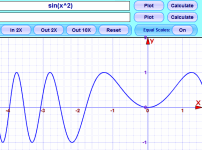
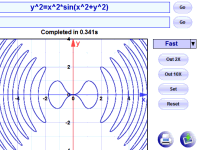
Explore the wonderful world of graphs. Create your own, and see what different functions produce. Get to understand what is really happening.

What type of Graph do you want?
You can explore ...
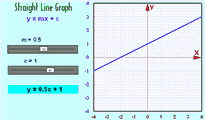
graph straight line
... the properties of a Straight Line Graph
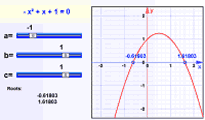
graph quadratic
... the properties of a Quadratic Equation Graph
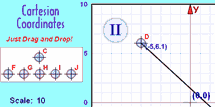
cartesian coordinates thumb
And also:
 
cool graphs
Try some Sample Graphs
graphapplet1
Make up a function like you use a calculator, then graph the result
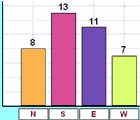
Bar Graphs

Thursday, 30 March 2017

Maths in every day life

 Maths in every day life
math-construction
Ask any contractor or construction worker and they’ll tell you just how important math is when it comes to building anything. Creating something that will last and add value to your home out of raw materials requires creativity, the right set of tools, and a broad range of mathematics.
Figuring the total amount of bags of concrete needed for a slab, accurately measuring lengths, widths, and angles, and estimating project costs are just a few of the many cases in which math is necessary in real life home improvement projects.
Some students may say they don’t plan on working in construction and this may be true, but many will own a home at some point in their life. Having the ability to do minor home improvements will save a lot of money and headache. Armed with math, they will also have the ability to check the work and project estimates, ensuring they’re getting the best value.
math-grocery-shopping
One of the more obvious places to find people using math in everyday life is at your neighborhood grocery store. Grocery shopping requires a broad range of math knowledge from multiplication to estimation and percentages.
Calculating price per unit, weighing produce, figuring percentage discounts, and estimating the final price are all great ways to include the whole family in the shopping experience.
Teacher Tip: Encourage your students to play math challenges at the grocery store with their family by attempting to estimate the total cost of all groceries prior to checkout. The difficulty can be increased by incorporating coupons, sales, and adjusted pricing for bulk items. Your little bargain shoppers will thank you later when they’re saving money on their own groceries.
math-baking-cooking
More math can be found in the kitchen than anywhere else in the house. Cooking and baking are sciences all their own and can be some of the most rewarding (and delicious) ways of introducing children to mathematics. After all, recipes are really just mathematical algorithms or self-contained step-by-step sets of operations to be performed. The proof is in the pudding!
Working in the kitchen requires a wide range of mathematical knowledge, including but not limited to:
  • measuring ingredients to follow a recipe
  • multiplying / dividing fractions to account for more or less than a single batch
  • converting a recipe from Celsius to Fahrenheit
  • converting a recipe from metric (mL) to US standard units (teaspoon, tablespoon, cups)
  • calculating cooking time per each item and adjusting accordingly
  • calculating pounds per hour of required cooking time
  • understanding ratios and proportions, particularly in baking (ex. the recipe calls for 1 egg and 2 cups of flour, then the ratio of eggs to flour is 1:2).
Following a recipe can sometimes be tricky, especially if conversions are necessary. We Americans follow our own set of rules when it comes to most forms of measurement. Conversions make it a bit more difficult to follow recipes from other countries as they most likely use Celsius and the metric system.
Celsius to Fahrenheit Conversion
Ex. The recipe calls for the oven to be set at 220°C, but yours is labelled by Fahrenheit.
Formula: °C  x  9/5 + 32 = °F
220 x 9/5 + 32 = °F
396 + 32 = 428°F
Metric to US Standard Unit Conversion
1 US legal cup = 240 mL
1 US tablespoon = 14.79 mL
1 US teaspoon = 4.92 mL
1 US fluid ounce = 29.57 mL
math-maps-travelling
Math comes in handy when travelling and shows up in various ways from estimating the amount of fuel you’ll need to planning out a trip based on miles per hour and distance traveled. Calculating fuel usage is crucial to long distance travel. Without it, you may find yourself stranded without gas or on the road for much longer than anticipated. You may also use math throughout the trip by paying for tolls, counting exit numbers, checking tire pressure, etc.
Long before GPS and Google Maps, people used atlases, paper road maps, road signs, or asked for directions in order to navigate throughout the country’s highways and byways. Reading a map is almost a lost art, but requires just a little time, orientation, and some basic math fundamentals. Teaching students how to use their math skills to read maps will make them safer travelers and less dependent on technology.
In order to use any map, you must first orient yourself, meaning to find your current position on the map. This will be point A. The simplest way to do this is to locate the town you’re in then the nearby crossroads, intersection or an easily identifiable point such as a bridge, building, or highway entrance. Once you’ve established a starting point, locate where on you want to go (point B). Now you can determine the best route depending on terrain, speed limit, etc.
Fun Fact: If you really want to impress your friends, you can also navigate by using the sun in the daytime and stars at night.
sun-rises-east-to-west
Daytime Navigation: In the Northern Hemisphere, the sun rises in the east and sets in the west. Depending on the time of day, you can orient yourself based on the sun’s position in the sky. This gets a bit trickier around midday as the sun appears directly overhead at noon. The earth’s rotation around the sun and sun’s position overhead is also the basis for the sundial, Man’s first clock.
north-big-dipper
Nighttime Navigation: On a clear night in the Northern Hemisphere, you can locate Polaris (The North Star) by using one of the most recognizable celestial bodies, Ursa Major (The Big Dipper). Two stars on the outer edge of its “dipper” point to a bright star, which all other stars rotate around since it’s pointing to the North Pole.
math-saving-money
Many experts agree that without strong math skills, people tend to invest, save, or spend money based on their emotions. To add to this dilemma, those individuals with poor math fundamentals typically make greater financial mistakes like underestimating how quickly interest accumulates. A student who thoroughly grasps the concepts of exponential growth and compound interest will be more inclined to better manage debt.
Financial knowledge decays over time, so it’s important to keep young people involved. By continually showing how specific math lessons apply to real life financial situations and budgeting, kids can learn how to properly spend and save their money without fear or frustration.
math-time-management
Time is our most valuable asset. Without proper planning, the day can slip through out fingers and our list of duties and responsibilities can start to accumulate. In our fast-paced, modern world, we can easily fall behind and get overwhelmed with all that we have to do. Keeping on schedule has greater weight in our daily lives than ever in history, but it takes more math skills than simply reading a clock or following a calendar to stay on top of everything.

Thursday, 23 March 2017

Quadrilateral

Definitions and Examples

A quadrilateral is a closed figure with four straight sides. You can make a quadrilateral by taking (or imagining) anything straight and thin you might have handy: pens, toothpicks, chopsticks, etc. A square is one type of a special quadrilateral.

Quadrilateral made of pencils

However, just to make it interesting, try to use four things that are not all the same length. Place your objects so that each end of one touches the end of another. I used pencils to form my quadrilateral, as you can see here. I placed each pencil tip so that it touches the eraser of another pencil. That way, I get a closed figure, meaning there are no gaps between sides and no side extends past the end of another side. Now we have our quadrilateral with four straight sides.
Let's simplify the figure by replacing the pencils with segments:

Quadrilateral PNCL

Each point where two sides touch is called a vertex. We name each vertex with a capital letter. Let's name our quadrilateral with the four vertices: P, N, C, and L. It also has four sides: the segments PN, NC, CL, and LP. To name the whole quadrilateral, we choose any vertex as a starting point and list all of the vertices going around either clockwise or counterclockwise. There are many possible names, including PNCL, LCNP, or CLPN.
If you play around a little with the objects that form your quadrilateral, it might be possible that you get a shape that looks something like this:

Concave quadrilateral made of pencils

This is still a quadrilateral because it follows the definition; it has four straight sides that form a closed figure. Again, we can simplify the figure with segments and name the vertices.

Concave quadrilateral

This quadrilateral has four vertices: A, R, O, and W. It has four sides: segments AR, RO, OW, and WA. The whole quadrilateral could be named AWOR, ROWA, or AROW.
The two quadrilaterals, PNCL and AROW, are examples of two different types of quadrilaterals. There are several other special quadrilaterals, such as parallelograms, trapezoids, and kites, but we won't get into the properties specific to each of those types in this lesson. We are only going to discuss two categories of quadrilaterals. Let's look at how to tell the difference between those two types in the next section.

Preparing for a test?

Try a practice test for free!

Types and Properties of Quadrilaterals

Depending on how the sides of a quadrilateral are connected to one another, quadrilaterals can be divided into two categories: convex and concave. To tell the difference between a convex and a concave quadrilateral, draw (or imagine) segments between each pair of unconnected vertices. If both segments lie inside the quadrilateral, then the figure is convex. If one of the segments lies outside of the quadrilateral, then the figure is concave.

Comparing Convex and Concave Quadrilaterals